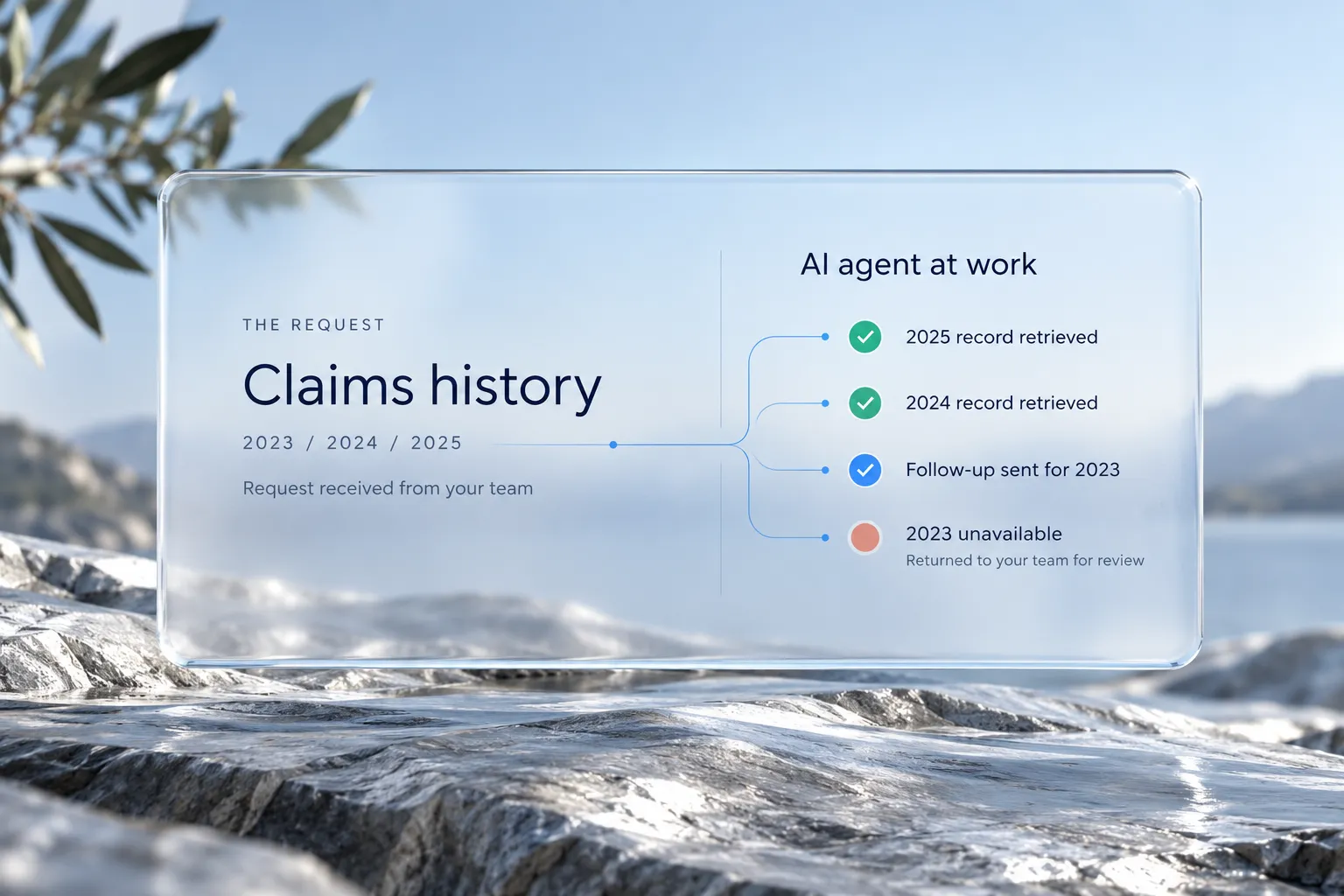
Use the distinction to design the work.
A rules-based workflow is useful when the inputs and next steps are predictable. An agent is useful when the system needs to interpret varied information or decide which permitted tool action to take.
The labels are used differently across the industry. Ask what the system can actually read, decide and do rather than treating “agent” as a guarantee of greater capability.
Choose by the uncertainty in the task.
A client record moving between two systems may need an integration and validation. An incoming carrier email explaining a missing document may require interpretation before the next step can be selected.
| Task | Likely building block | Control needed |
|---|---|---|
| Copy approved fields to another system | Rules and integration | Validation, duplicate handling and recovery |
| Interpret an unstructured reply | AI interpretation | Representative tests and uncertainty handling |
| Decide the next permitted retrieval action | Agent with tools | Scoped permissions and activity history |
| Approve a consequential exception | Responsible person | Clear context and recorded decision |
Autonomy is a design choice.
An agent should not receive broader access simply because it can generate an action. Define its goal, available tools, permitted records, approval requirements and stopping conditions.
A reliable system may allow automatic retrieval but require approval before sending a message or changing a sensitive record. The right boundary depends on the action and the business, not a universal confidence score.
Test the failure cases.
Try incomplete requests, contradictory attachments, repeated messages, unavailable tools and ambiguous responses. Check whether the system stops, escalates or recovers with enough context for the team.
Measure the accepted work and correction effort, not only how many tasks the model attempted. Track cost and response time alongside quality. The engineering question is whether the operating workflow is better, including its failures.
What this looks like in the carrier-request project.
The system combines interpretation of email and document context with deterministic authorization and state rules. It coordinates follow-up and document collection while exceptions route to people.
That is why “an AI agent sends reminders” is an incomplete description. The surrounding record model, completion conditions and review process make the actions useful.